
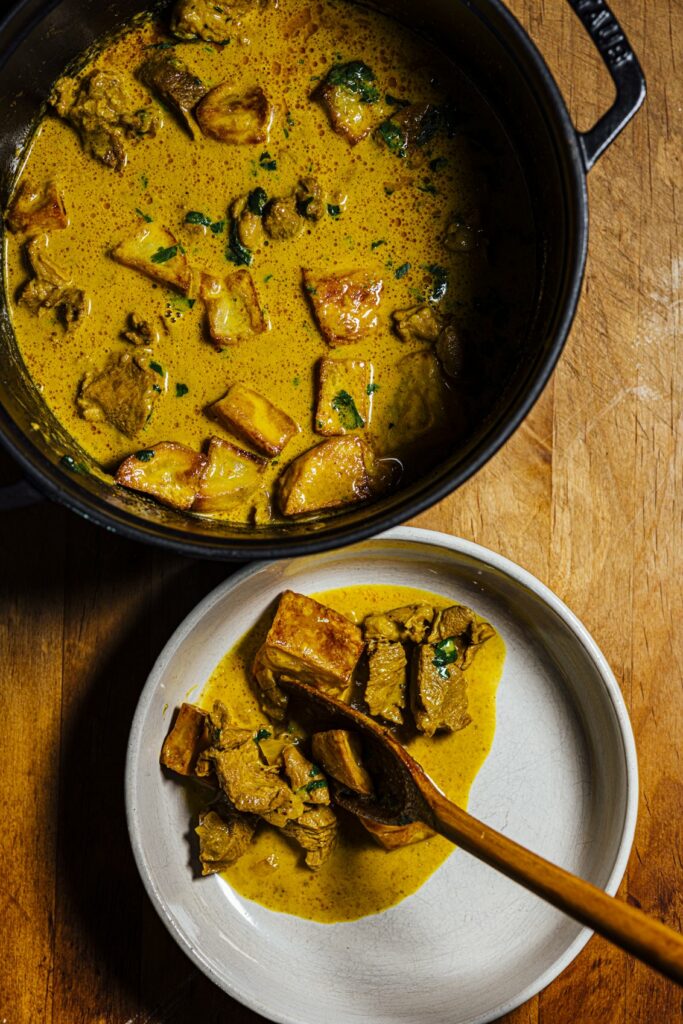
Goan Lamb Curry
This Goan lamb curry post was sponsored by the American Lamb Board. All opinions expressed are solely my own.
A simple yet soothing Goan lamb curry that is rich with the aroma of coconut and spices. Oven-roasted potatoes and tender, succulent pieces of lamb are put together in this luscious coconut-based stew. I prefer to eat it with plain rice or bread to enjoy every drop of that flavorful liquid.
Goan Lamb Curry: The Science, History, and Flavor of a Coastal Classic
This Goan lamb curry is a coconut-based stew where tender, braised lamb and crispy oven-roasted potatoes come together in a fragrant, gently spiced sauce. It’s one of the most comforting dishes from India’s west coast and a beautiful example of how fat, acid, and spice build on each other to create something deeply satisfying.
If your curry turns out bland, thin, or with tough meat, the issue usually comes down to spice sequencing, braise time, and how you handle the coconut milk.
Why This Goan Lamb Curry Works
This recipe has three distinct stages, and each one matters. First, the spices bloom in oil so their fat-soluble aroma compounds fully saturate the lamb. Then the meat braises low and slow with a small amount of water until genuinely tender. Finally, coconut milk and acid go in off the heat, which keeps the sauce from curdling and preserves the coconut’s delicate flavor.
A few specific decisions make this version reliable:
- Blooming ground spices in oil (tadka) releases volatile aroma molecules and distributes them evenly through the dish.
- Braising over low heat with a tight lid builds collagen breakdown in the lamb shoulder without drying it out.
- Adding lemon or lime juice before the coconut milk lowers the pH of the liquid slightly, which reduces the risk of the coconut milk breaking when it hits the hot sauce.
- Roasting the potatoes separately keeps their exterior crisp and their interior fluffy, rather than letting them turn soft and waterlogged in the braise.
What Is Goan Lamb Curry?
Goa sits on the western coast of India, and its cuisine reflects centuries of layered influences: the spice trade, Portuguese colonialism, and the abundance of the Arabian Sea. Coconut is the backbone of Goan cooking. The trees appear everywhere along the coastline, and nearly every part of the plant finds use in the kitchen: the water, the tender flesh, the mature grated coconut, and the thick pressed milk.
This lamb curry draws from that tradition. It is a braised stew, not a quick sauté. The spices are warmer than the fiery vindaloo Goa is internationally known for, and the coconut milk gives the sauce its characteristic velvety body. Malt vinegar or citrus juice cuts through that richness and keeps the final dish from feeling heavy.
Unlike many restaurant interpretations, this version does not use a pre-made curry paste. The flavor is built from individual spices, which gives you more control over the final result.
A Note on Goa’s Coconut Tradition
If one ingredient connects me to my childhood on the west coast of India, it is coconut. Growing up in Bombay and visiting my grandparents’ home in Goa, coconut trees were a constant presence. The leaves were woven into baskets; the young coconuts were opened for their sweet water and tender flesh; the mature coconuts were pressed into thick gravies, stews, and curries. The oil formed the flavor base for sweet and savory dishes alike.
This Goan lamb curry is rooted in that same tradition. The coconut milk is not a shortcut here. It is the point.
The Flavor Science Behind This Goan Lamb Curry
1. Why the Spice Order Matters
The recipe begins by blooming garam masala, black pepper, Kashmiri chilli, turmeric, and cardamom directly in hot oil. This step is not optional. Fat-soluble aroma compounds in spices require a lipid to dissolve into. When you add ground spices to hot oil, the volatile molecules that carry flavor and aroma are extracted and distributed far more effectively than they would be if stirred into water or added directly to the meat.
Kashmiri chilli powder is worth singling out here. It is a mild chilli ground from dried Kashmiri peppers, and its value in this dish is more about color and warmth than heat. The curcumin in turmeric reinforces that golden hue, and together they give the finished curry its characteristic amber color.
2. What Happens to Lamb During a Long Braise
Lamb shoulder is a working muscle, which means it contains significant connective tissue in the form of collagen. When you cook it quickly, the muscle fibers tighten and the meat turns tough. When you cook it slowly in a covered pot with liquid, the collagen gradually converts to gelatin. This transformation is what makes the lamb “fall apart under the pressure of a fork,” as the original recipe describes. It requires sustained low heat over roughly an hour.
The USDA recommends lamb reach an internal temperature of 145°F (63°C) with a 3-minute rest, but for this braised application, you are cooking well past that point to achieve the collagen conversion that makes shoulder meat tender.
3. Coconut Milk and Acid: Why They Go In Last
Coconut milk is an emulsion of fat droplets suspended in water, stabilized by proteins found in the coconut. High heat, especially in the presence of salt or prolonged cooking, can destabilize that emulsion. The proteins denature and the fat separates out, leaving a broken, grainy sauce.
Adding lemon or lime juice before the coconut milk introduces acid, which helps moderate the reaction when the coconut milk hits the hot pot. Removing the pot from the burner before stirring in the coconut milk and then bringing it only to a gentle simmer further reduces that risk. The result is a smooth, cohesive sauce.
Key Ingredients for Goan Lamb Curry
Lamb shoulder: Boneless shoulder is ideal for this recipe. It has enough fat and connective tissue to become tender and richly flavored during a long braise. If your butcher only carries bone-in shoulder, ask them to trim and cube it, or do it at home. Avoid lean cuts like leg, which can dry out.
Garam masala: Homemade is always better (see my garam masala recipe), but a good store-bought blend works. Different brands vary in intensity, so taste as you go.
Kashmiri chilli: Ground Kashmiri chilli is mild and deeply red. It contributes color and gentle warmth. If you cannot find it, a combination of sweet paprika and a small amount of cayenne is a workable substitute.
Coconut milk: Use full-fat, plain unsweetened coconut milk for the best texture. Light versions are thinner and can make the sauce less cohesive.
Lemon or lime juice: Either works. Lime leans slightly more aromatic; lemon is a little sharper. Use whichever you prefer. Do not skip the acid entirely.
Make-Ahead, Storage, and Reheating
Make-ahead: The lamb can be braised a full day ahead and refrigerated. The coconut milk and acid are best added just before serving to maintain the sauce’s texture. If you add the coconut milk ahead of time, reheat gently over low heat and avoid boiling.
Storage: Leftovers keep well in an airtight container in the refrigerator for up to 3 days. The sauce will thicken as it chills; a splash of water loosens it when reheating.
Roasted potatoes: These are best made fresh. They lose their crispness in the refrigerator. If you are planning ahead, store the braised lamb and the roasted potatoes separately and combine just before serving.
Freezing: The braised lamb (without the coconut milk) freezes well for up to 2 months. Thaw overnight in the refrigerator, reheat gently, then stir in fresh coconut milk and lemon juice to finish.
Print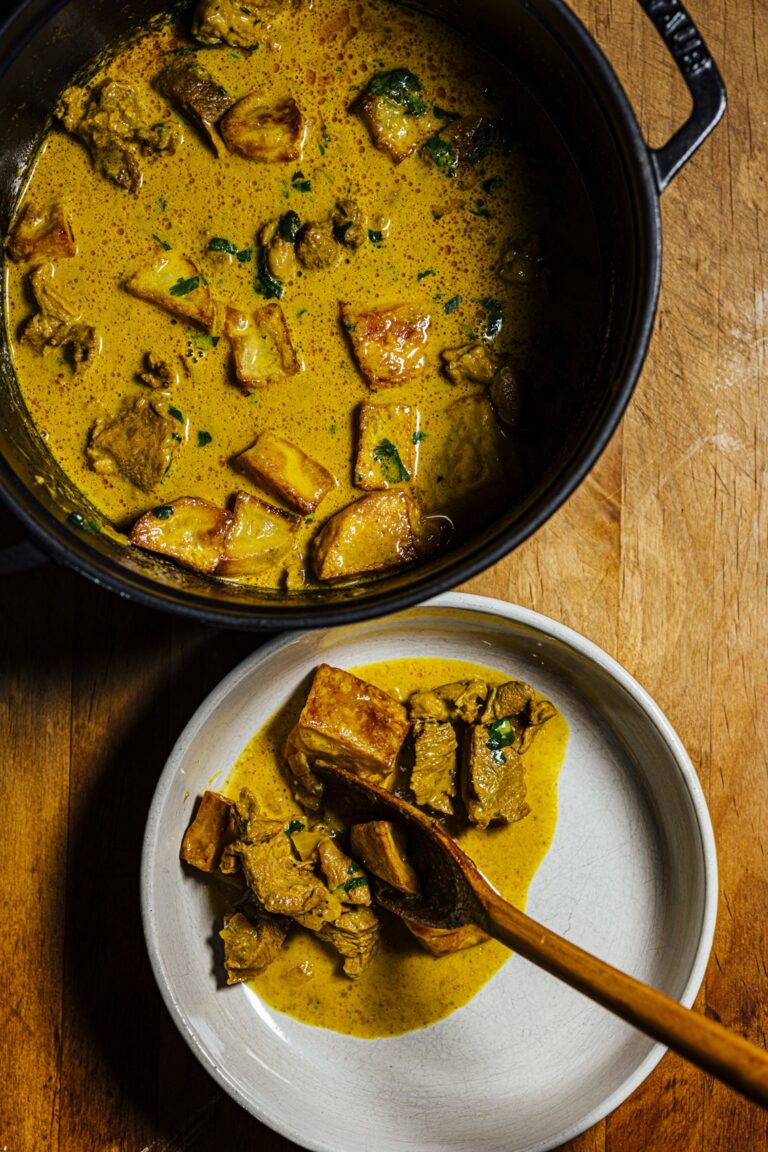
Goan Lamb Curry
A simple yet soothing lamb curry from Goa that is rich with the aroma of coconut and spices. Oven-roasted potatoes and tender, succulent pieces of lamb are put together in this luscious coconut-based stew. I prefer to eat it with plain rice or bread to enjoy every drop of that flavorful liquid.
- Yield: 4
Ingredients
3 Tbsp/45 ml neutral oil, such as grapeseed
1 ½ tsp garam masala, homemade or store-bought
1 tsp ground black pepper
½ tsp ground Kashmiri chilli
½ tsp ground turmeric
½ tsp ground cardamom
1 large/300 g white or yellow onion, diced
2 Tbsp grated garlic
2 Tbsp grated ginger
1 ½ lb/ g boneless American lamb shoulder, excess fat trimmed and discarded, cut into 1 in/2.5 cm pieces
½ cup/120 ml water
1 large/400 g Russett potato, peeled and cut into 1 in/2.5 cm cubes
1 cup/240 ml plain unsweetened coconut milk
2 Tbsp fresh lemon or lime juice
2 Tbsp chopped cilantro, tender stems and leaves
Instructions
- Heat 2 Tbsp of the oil in a medium Dutch oven or saucepan with a heavy lid over medium heat. Add the garam masala, black pepper, Kashmiri chilli, turmeric, cardamon, and sauté until fragrant, 30 to 45 seconds. Add the onion and sauté until translucent and soft, 4 to 5 minutes. Stir in the garlic and ginger and cook for 1 minute. Fold in the lamb. Sauté the lamb until the meat starts to brown, 8 to 10 minutes. Add the water and ½ tsp salt. Bring to a boil over medium-high heat. Reduce to a simmer, cover, and cook until the lamb is tender about 1 hour. USDA recommends lamb reach an internal temp of 145F/63C with a 3-minute rest.
- While the lamb cooks, preheat the oven to 400F/200C. Spread the potatoes out onto a rimmed baking sheet. Toss the potatoes with 1 Tbsp oil and ½ tsp salt, spread in a single layer, and roast in the oven until the outside is golden brown and crisp while the insides are soft and easily pierced with a knife, 25 to 30 minutes. Remove from the oven.
- Once the lamb is cooked, stir in the coconut milk and lemon juice. Taste and season with salt. Add the potatoes and garnish with the cilantro. Serve hot or warm. Leftovers will stay good for up to 3 days if stored in an airtight container in the refrigerator.
Notes
- If you can’t find boneless stew lamb, use a boneless shoulder cut and either get the butcher to trim the fat off and chop it or do it at home. I prefer to use American Lamb in my cooking because of the high quality of the meat that produces the best flavor and texture in this curry.
- I prefer a Dutch oven to make this curry because the lid is heavy and holds steam well. This, in turn, helps the lamb cook faster and turn more tender.

From the book
Love the flavors of Goa?
This lamb curry works because of a balance of richness, acidity, spice, and aroma. Coconut milk softens the heat, vinegar brightens the sauce, and warm spices create depth that develops as the curry cooks.
In Fundamentals of Flavor, I explore these flavor relationships through recipes such as Goan Feijoada, Goan Mussels with Malt Vinegar and Coconut Milk, Goan Meatballs in Tomato Curry, Chicken Biryani, and My Tandoori Chicken.
You’ll learn how ingredients like acid, fat, heat, and aromatics work together so you can build deeper flavor in any dish.
Preorder Fundamentals of Flavor →100 recipes · Science-backed techniques · September 2026
Complete Your Table
If you enjoyed this Goan lamb curry, these recipes round out the meal:
- Homemade Naan: The best thing to do with the sauce at the bottom of the bowl.
- Basmati Rice: Learn the starch and hydration science behind perfectly separate, fluffy grains.
- Kachumber Salad: A crisp, acidic counterpoint to the richness of the coconut braise.
- Garam Masala: Make your own spice blend from scratch and control the flavor from the first step.
Frequently Asked Questions
Can I use bone-in lamb instead of boneless?
Yes. Bone-in pieces will add even more gelatin and flavor to the braise, which deepens the sauce. Just adjust your cooking time slightly and remove the bones before serving if you prefer.
What can I use instead of lamb?
Bone-in or boneless goat shoulder is a traditional substitute in Goan cooking and works beautifully here. Beef chuck is a reasonable option if neither is available, though the flavor profile will be different.
Can I skip roasting the potatoes and add them directly to the pot?
You can, but the texture will be softer and the potatoes will absorb more of the braise liquid. Roasting them separately keeps their exterior crisp, which provides textural contrast in the finished dish.
Why did my coconut milk curdle?
The most likely cause is high heat after adding the coconut milk. Keep the heat low once the coconut milk is in and avoid boiling. Adding the lemon or lime juice before the coconut milk also helps stabilize the sauce.
Can I make this dairy-free and gluten-free?
This recipe is already both dairy-free and gluten-free. No modifications needed.
How do I know when the lamb is done?
The lamb should be tender enough to break apart easily with a fork. This typically takes about 1 hour of covered simmering on low heat. The USDA recommends an internal temperature of 145°F (63°C) with a 3-minute rest, but for braised shoulder meat you are cooking past that point to achieve genuine tenderness.

7 Responses
A luscious lamb stew indeed! Tender lamb pieces cooked to perfection in a delicious sauce. An easy, straightforward recipe for total success. Nick is a flavor genius. I love his recipes!
Just like he suggested, I served it simply with basmati rice and homemade naan. If you like lamb, you will love this!
Thank you so much; I am so happy you loved this, June!
Love this recipe. I prefer to use fresh lime juice and boil rather than roast or fry the potatoes as the curry is already quite rich. Also New Zealand halal lamb is perfect for this.
This was delicious. My husband couldn’t stop raving about it. I added 2 bundles of steamed (thoroughly cooked ) Lacinto kale (stems removed) 10 minutes before the lamb was done I also doubled the Kashmiri chili powder. I also used lime, not lemon. Great recipe!
Great recipe. Along with the kashmiri chili, I also added some cayenne as I like my curry more pungent. The true Goan in me!
Thank you for sharing this amazing recipe, we absolute love it.
This Goan Lamb Curry looks absolutely mouthwatering! I love how you’ve captured the rich flavors of Goan cuisine. Can’t wait to try this recipe at home—thanks for sharing!