
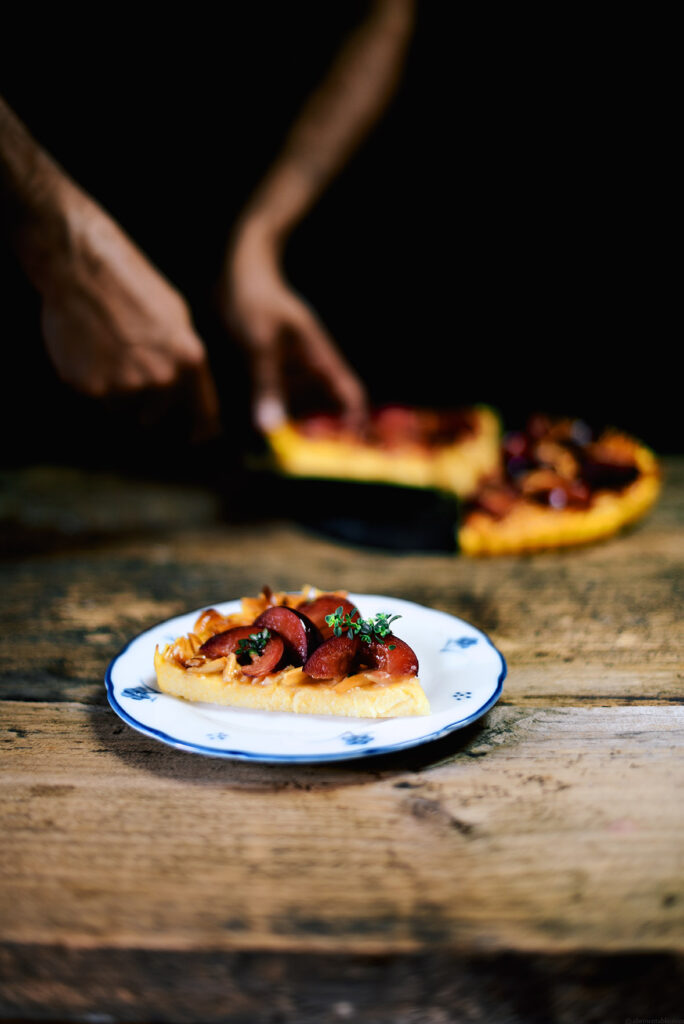
Almond Polenta Tart: A Corn-Based Crust Worth Knowing
This almond polenta tart with sherried plum compote is one of those desserts that teaches you something useful: cornmeal can do far more than savory work. The polenta forms a tender, honey-scented base topped with butter-glazed almonds and finished with a macerated plum compote perfumed with sherry, thyme, and cinnamon. It’s a genuinely different kind of tart, and it holds together beautifully.
If you’ve never made a polenta-based tart before, the process is straightforward. The crust sets up without any blind baking or pie weights. It just needs time and a 400°F (200°C) oven.
Why This Almond Polenta Tart Works
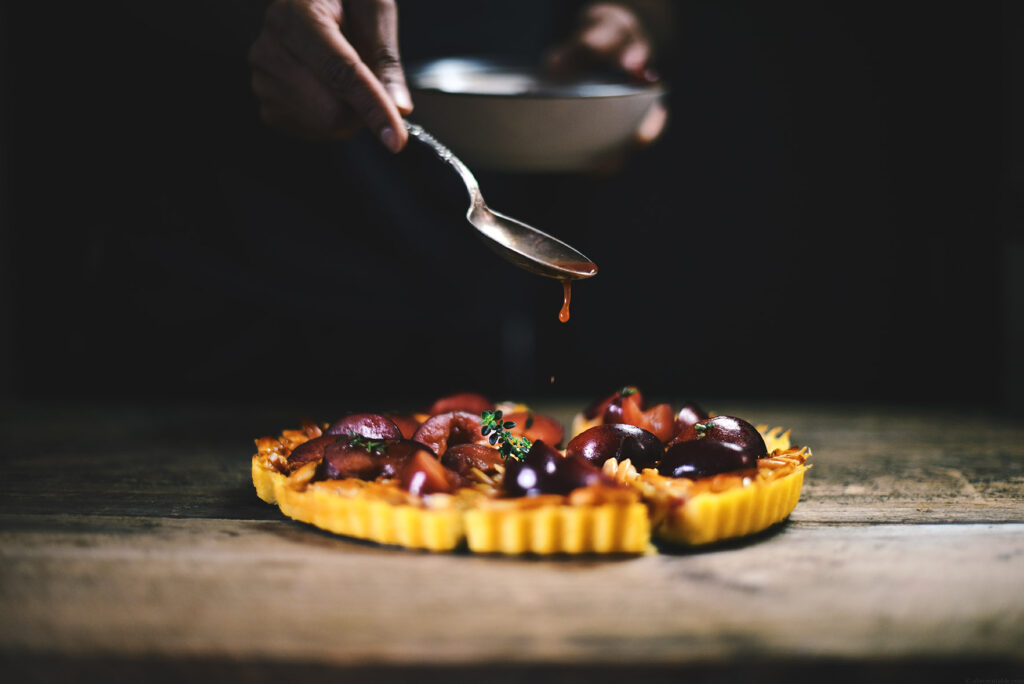
The structure of this tart comes from how polenta behaves as it cools. When hot, the cooked cornmeal is pourable and spreadable. As it sits at room temperature, the starch granules recrystallize and the mixture firms into a sliceable crust that holds up to the wet compote placed on top.
A few things make this particular recipe especially good:
- Honey in the polenta adds sweetness and helps with browning during baking, because the sugars in honey caramelize at relatively low temperatures.
- Pricking the surface before baking allows steam to escape evenly, which prevents the crust from heaving in the oven.
- Macerating the plums in sherry draws out their juices before cooking begins, concentrating flavor and producing the compote’s deep, jammy quality without requiring long stovetop time.
What Is Polenta, and Why Use It in this Almond Tart?
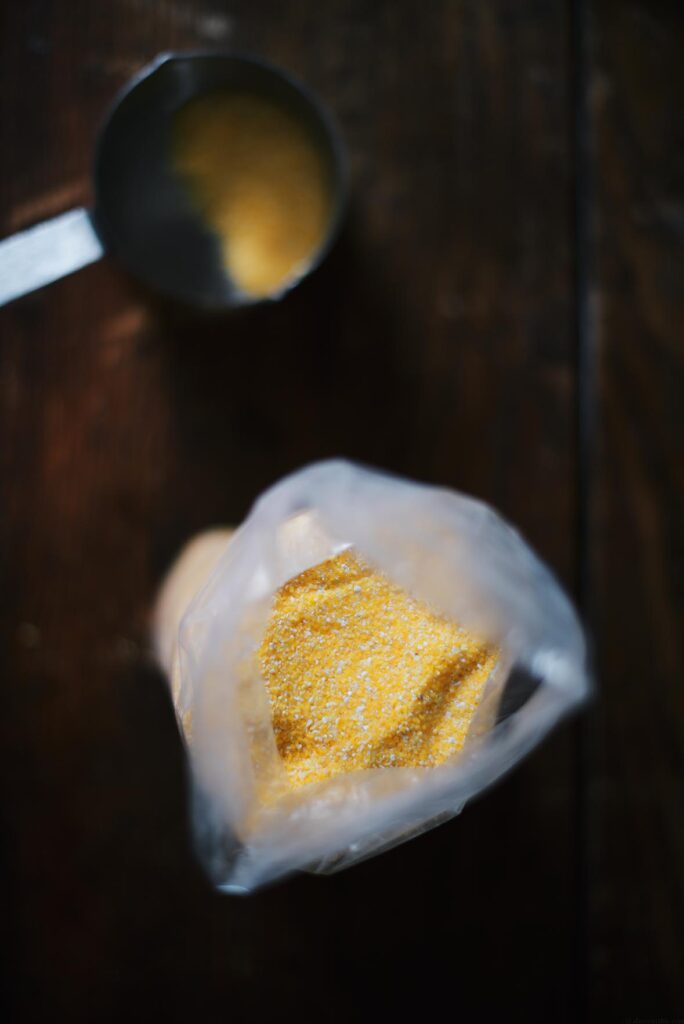
Polenta is dried, ground corn, traditionally cooked in water or milk until the starch absorbs the liquid and the mixture thickens. Medium-grind polenta works best here: it’s fine enough to produce a smooth surface but coarse enough to give the tart some texture and a distinct corn flavor.
Unlike a traditional pastry crust, which relies on fat inhibiting gluten development for tenderness, a polenta crust achieves its texture entirely through starch gelatinization and retrogradation. There’s no flour, no rolling, and no risk of overworking the dough. That also makes this tart naturally gluten-free.
Why Sherry in the Compote?
Dry sherry contributes both acidity and a gentle oxidative flavor, the result of the solera aging process used to produce it. That slight nuttiness pairs well with stone fruit. If you don’t have sherry on hand, dry apple juice works as a substitute, though the flavor profile shifts in a fruitier direction.
A Note on the Almond Polenta Tart’s Origins
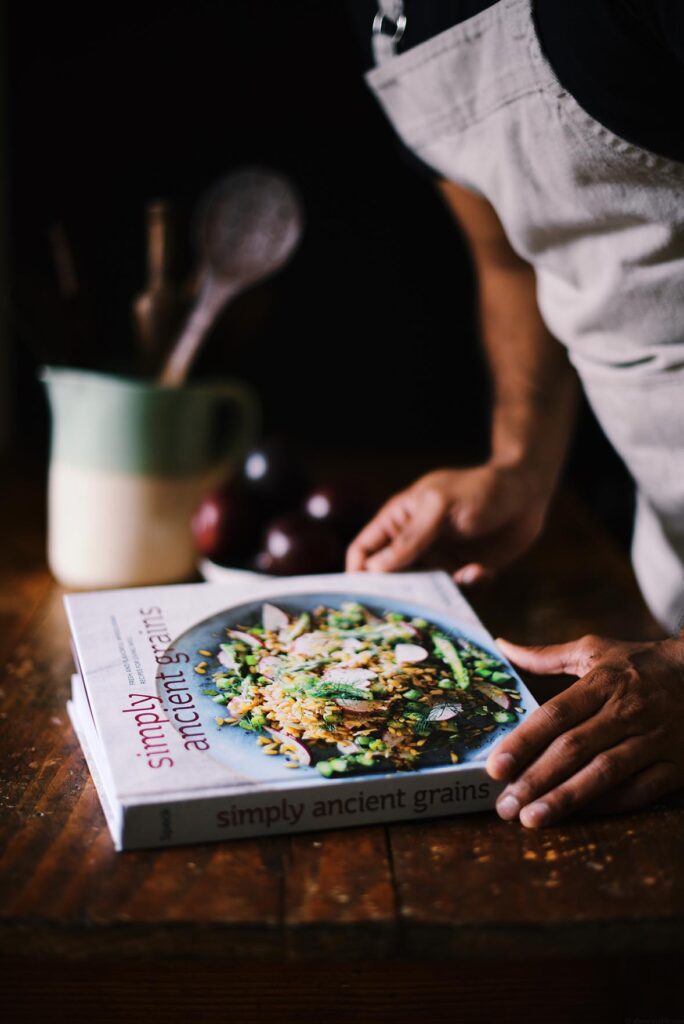
This recipe comes from Maria Speck’s book Simply Ancient Grains , a beautifully written collection built around whole and ancient grains. Maria’s approach to grains is practical and wide-ranging, and this tart is a good example of how a grain more often found in savory cooking can anchor a dessert with real elegance.
Print
almond polenta tart with sherried plum compote
- Yield: 8
Ingredients
For the Polenta
2 cups/480 ml water
1 1/2 cups/360 ml whole or low-fat milk
1/4 cup/85 g runny honey
1/2 tsp fine-grain sea salt
1 cup/150 g polenta, preferably medium grind
For the Compote and to Finish
2 lb/910 g fresh plums, pits removed and cut into 1/2 to 3/4 in/13 mm to 2 cm pieces (if plums are small, cut into wedges)
1/2 tsp ground cinnamon
4 Tbsp honey, or more as needed
1/4 cup/60 ml dry sherry or apple juice
1 Tbsp brandy (optional)
1 Tbsp + 1 tsp fresh thyme leaves (I used lemon thyme)
1/4 cup/60 g unsalted butter, preferably the European-style
1 cup/30 g sliced almonds ( I used slivered)
softly whipped, lightly sweetened heavy cream or creme fraiche for serving (optional)
Instructions
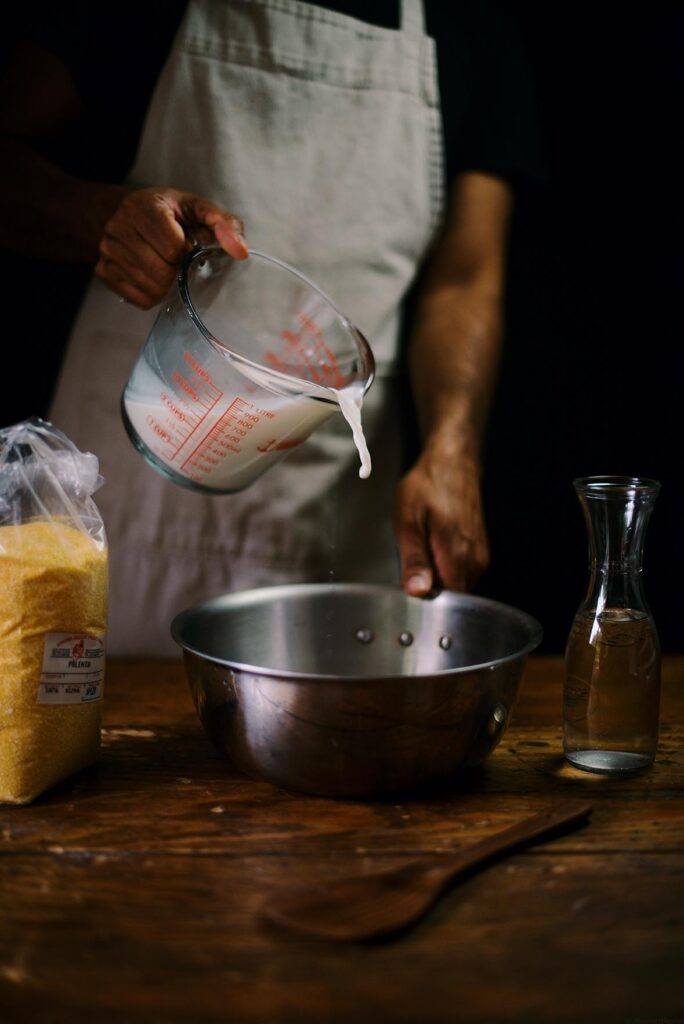
- To prepare the polenta, add the water, milk, honey, and salt to a large, heavy saucepan, heat on medium-high, and bring to a bare simmer, stirring occasionally. Using a large whisk, add the polenta in a slow and steady thin stream and continue to whisk for 1 minute. Reduce the heat if the mixture starts to bubble profusely. Reduce the heat, cover the saucepan with a lid, and cook for 10 minutes. Stir vigorously with a wooden spoon every few minutes to prevent the polenta from sticking to the bottom. Remove the saucepan from the stove and let it sit, covered for 10 minutes, stirring well once or twice.
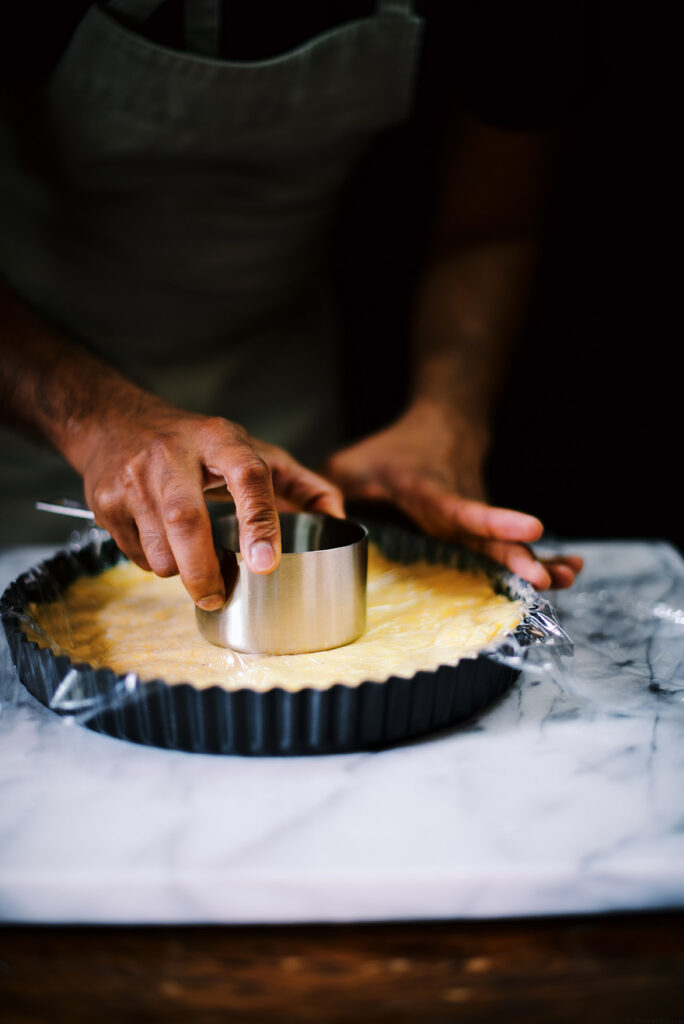
- Butter a 10 in/25 cm tart pan and place it on a wire rack. Transfer the polenta to the pan and spread evenly to form a smooth layer. You can dip a wooden spoon in cold water and then spread the mixture. The other way to do this is to place a large sheet of clingfilm over the polenta in the pan and spread the mixture out evenly in a layer using the flat base of a measuring cup. Set the prepared tart pan aside to firm for about 45 minutes to 1 hour. Prick the surface of the polenta with the round end of a spoon about 12 times by inserting the spoon at a 45-degree angle into the tart. Dip the spoon in cold water between each insertion to prevent sticking. This will allow even baking of the tart and prevent heaving during baking.
- To bake the tart, place a wire rack in the center of the oven and preheat to 400F/200C.
- While the oven preheats, prepare the plum compote. Add the plums to a large mixing bowl. Add the cinnamon, 2 Tbsp of honey, sherry, brandy, and 1 Tbsp of thyme. Toss gently to combine, taste and add more honey if desired. Cover and chill to macerate, stirring gently once or twice. (I left it to chill for about two hours)
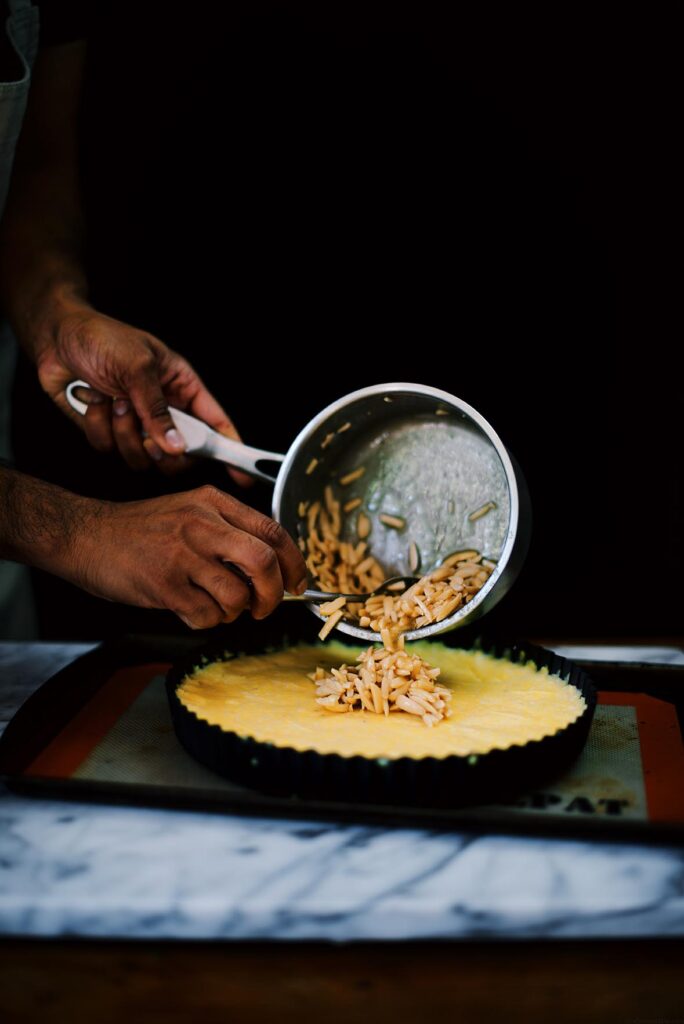
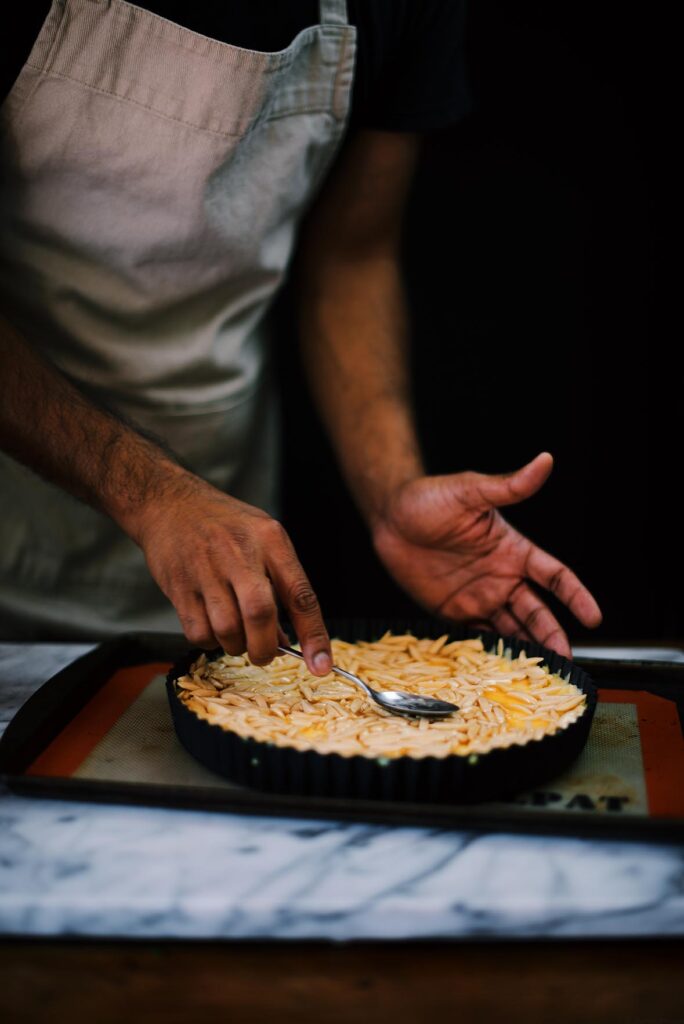
- Add the butter and the remaining 2 Tbsp of honey to a medium skillet. Heat on medium and stir occasionally with a spoon until blended. Fold in the almonds and stir until the almonds are coated, and the mixture starts to foam, about 1 to 2 minutes. Remove from heat and immediately spread the almonds on the surface of the polenta, using the back of the spoon.
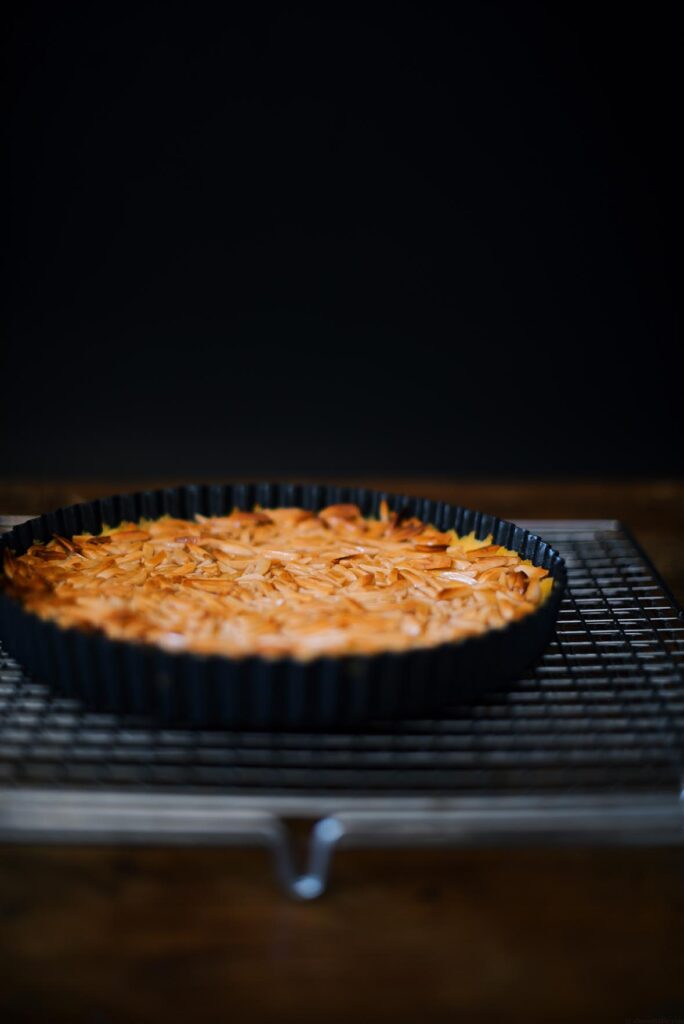
- Bake the prepared tart for about 20 minutes until the small bubbles appear around the edges and the almonds glisten golden brown. Transfer the tart pan to a wire rack and cool for 20 minutes to allow to set before cutting.
- To serve the tart, cut it into 8 wedges with a sharp serrated knife. Place each wedge on a dessert plate and spoon a generous amount of the prepared chilled compote with some juices. Garnish each serving with a little fresh thyme leaves and, if desired, a dollop of whipped cream.
Key Ingredients For This Almond Polenta Tart
Polenta (medium grind): The grind matters here. Fine polenta sets too smoothly and loses the slight textural contrast that makes this crust interesting. Coarse polenta may not set firmly enough to slice cleanly. Medium grind is the target.
Honey: Runny, liquid honey is what the recipe calls for. It disperses evenly into the hot polenta as you whisk. A strongly flavored honey like buckwheat will compete with the thyme and sherry in the compote; a milder variety such as acacia or clover keeps the balance right.
Dry sherry: Fino or manzanilla are the driest options and both work well. Avoid cream sherry, which is sweet and will throw off the balance of the compote.
Fresh thyme: Lemon thyme, if you can find it, adds a citrus note that brightens the plum compote. Regular thyme works fine. Dried thyme is not a substitute here; the delicate volatile oils that give fresh thyme its flavor dissipate quickly during drying.
Sliced or slivered almonds: Either works. Slivered almonds produce slightly more distinct pieces in the finished topping; sliced almonds tend to cluster together in a more cohesive layer. Both get coated in the honey-butter glaze and brown well in the oven.
Make-Ahead, Storage and Reheating
You can make the almond polenta tart base a day ahead. After spreading it into the tart pan, cover with plastic wrap and refrigerate overnight. Bring to room temperature before adding the almond topping and baking.
Make the compote at least 1 to 2 hours ahead. The macerating time allows the plums to release their juices and the sherry and thyme to infuse. It can be made up to 2 days in advance and stored covered in the refrigerator.
Baked tart keeps at room temperature, covered, for up to 1 day. For longer storage, refrigerate for up to 3 days. The compote should be stored separately and spooned over just before serving.
Complete Your Table
If you enjoyed this almond polenta tart, here are a few more recipes worth trying:
- Fig Leaf Buttermilk Ice Cream and Spiced Pineapple Compote: Another fruit compote pairing, this time built around the grassy, coconut-like flavor of fig leaves infused into the cream.
- Almond Apricot Honey Cake: Stone fruit and almonds in a different register, with a moist crumb and honey-forward flavor.
- Charred Broccolini with Fava Beans in Vinegar: If you’re building a full menu around this tart, this vegetable dish makes a sharp, acidic counterpoint to open the meal.
Common Substitutions
Can I use instant polenta? Instant polenta cooks faster but produces a softer, stickier set. It may not firm up enough to hold its shape as a tart base. If instant polenta is all you have, increase the polenta-to-liquid ratio slightly and allow extra firming time before baking.
Can I use frozen plums? Fresh plums are strongly preferred here because the maceration step relies on the fruit releasing its own juices slowly. Frozen plums release liquid very quickly when thawed and can produce a watery compote. If fresh stone fruit isn’t available, firm fresh peaches or nectarines are a better substitute than frozen plums.
Do I need a tart pan with a removable bottom? A removable-bottom pan makes serving significantly easier because polenta doesn’t release cleanly the way a pastry crust might. If you only have a fixed-bottom tart pan, line it with parchment paper before adding the polenta.
Can I make this dairy-free? The polenta can be made with a full-fat plant-based milk such as oat or cashew in place of whole milk. For the almond topping, use a plant-based butter; the texture will be similar though the flavor will differ slightly. Serve with coconut whipped cream instead of whipped heavy cream.
What does the brandy do, and can I skip it? The brandy is optional. It adds a small amount of alcohol-soluble aroma compounds to the compote and deepens the fruit flavor. You can skip it without affecting the structure of the dish.
Why do I prick the polenta with the back of a spoon rather than a fork? The recipe calls for inserting a spoon at a 45-degree angle rather than poking straight down, which creates small channels for steam to escape rather than breaking through the surface completely. A fork would create openings that are too small and too numerous to achieve the same effect.

14 Responses
I’ve been on a similar journey with grains, only I tend to go back and unearth the grains my grandmothers used, something I am a little familiar with like millet, buckwheat, spelt, semolina. Surprisingly, as soon as I taste any of my creations the taste of childhood immediately springs back. My brain forgot but my tastebuds remember, which is pretty amazing!
This polenta tart is stunning, Nik! Just when I think your photography can’t get any better you go a step further.
How beautiful this tart can be! <3
This sentence……
"There’s honey and butter glazed layer of sweet almonds that give a toffee like flavor along with with a delicious cinnamon and thyme flavored fresh plum compote that’s served over the polenta tart."
…perfection.
This looks so beautiful. I love polenta in savory and sweet dishes its so versatile. The sherried plum compote sounds wonderful.
This is amazing, Nik! Stunning photos, and what a yummy recipe.
Absolutely gorgeous!! I love all the actions shots 🙂
Gorgeous shots! And of course Maria’s tart looks incredibly delicious. Love her books. Can’t wait to try it with all your tips. Excellent post! 🙂
Gorgeous tart, I love that plum compote!
How much honey goes in the polenta? Listed in directions, but not ingredients list. This tart sounds heavenly!
Thanks, Rianna. I’ve corrected the typo! It’s an easy and tasty tart to make at home.
is it possible to substitute agave for honey? 1/4 cup agave for 1/4c honey? i am also trying to make it vegan so i am going to try earth balance instead of butter and almond milk instead of cows milk. crossing fingers!
Hi Shauna, I think that should work just fine. Good luck with making it vegan, I haven’t tried Maria’s recipe this way but I’m sure it will delicious!
Nick, this looks heavenly and I would love to make it for a small dinner party! I presume that the plum compote is spread over the toasted almonds and not baked or did I miss something?
Yup, it’s listed in Step 7 of the recipe.