
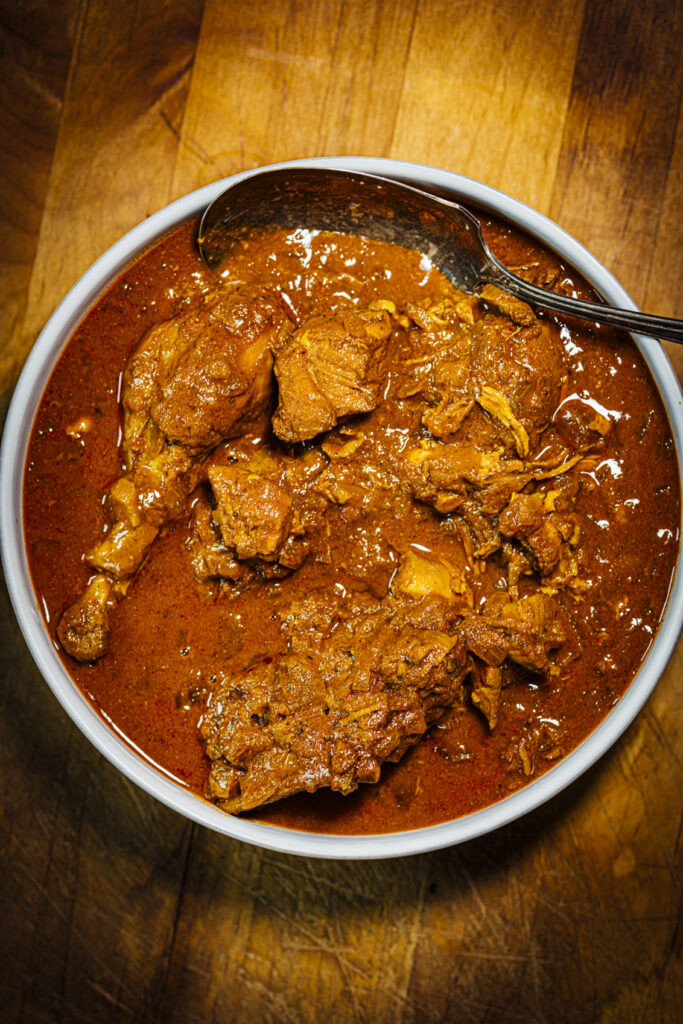
One of the most popular Goan dishes is vindaloo. Vindaloo is made with pork, and to be perfectly honest, the first time I heard of it made with chicken was after I moved to America and visited an Indian restaurant. My family makes pork vindaloo at Christmas, Easter, and any other big celebration and chicken vindaloo is a rarity. However, chicken vindaloo is a fantastic option for those who don’t eat pork. I’ve seen some restaurants in America add potatoes to chicken vindaloo. Potatoes aren’t meant to be in this dish. I don’t mind them, but I’ve left them out here. The quantity of spices used might appear large, but this recipe uses a large quantity of vinegar, and the flavors need to stand up to it.
Vindaloo is a bright red, spicy, vinegary dish I love eating with bread or rice. It benefits from some starch to balance the sourness of the dish and help sop up all that delicious gravy.
Chicken Vindaloo: The Science, History & Flavor of Goa’s Iconic Dish
This chicken vindaloo recipe is a bold, deeply spiced Goan dish with a characteristic bright red color and a sharp vinegar edge that sets it apart from most Indian curries. If your vindaloo turns out flat, too sour, or with rubbery chicken, the answers almost always come down to marination time, acid management, and spice concentration.
Why This Chicken Vindaloo Recipe Works
Chicken vindaloo is naturally gluten-free and paleo-friendly, and it’s also a precise study in how acid, fat, and heat interact with meat and spice. Several choices in this recipe are deliberate:
- Short marination time (30 minutes) protects the chicken from the toughening effect of acetic acid in vinegar.
- Blending the spices with vinegar and water creates a smooth paste that coats every piece of chicken evenly.
- Cooking low and slow with a lid allows the chicken to braise gently in the spice paste without drying out.
- A full day of rest in the refrigerator allows the flavors to develop and mellow, rounding the sharp edges of the vinegar.
What Is Chicken Vindaloo?
Vindaloo is a dish rooted in Goan cuisine, known for its intense red color from Kashmiri chillies, a pronounced sourness from vinegar, and a deep warmth from cloves and cinnamon. Unlike the pork version, which is traditionally made weeks in advance and stores well due to its high acidity, chicken vindaloo is a faster weeknight-friendly adaptation. It can be eaten the day it’s made, though the flavors improve noticeably after a night in the refrigerator.
This is not a mild curry. It is assertive, vinegary, and meant to be paired with something starchy — rice, crusty bread, or parathas — to bring balance to the dish.
A Brief History: From Portugal to Goa
The word vindaloo comes from the Portuguese dish carne de vinha d’alhos, which refers to meat cooked with wine and garlic. When the Portuguese colonized Goa, they brought new ingredients, including chillies and vinegar, that quickly became part of the local culture and cuisine. Vindaloo is one of those dishes that arose during that period of exchange.
The high acidity of the vinegar served a practical purpose: it prevented the growth of harmful bacteria, helped tenderize pork, and extended the shelf life of the dish, particularly useful on long sea voyages. Over time, the dish became central to Goan Christian holiday cooking, and it remains a staple at Christmas and Easter tables.
The chicken version you see in many Indian restaurants in the United States and United Kingdom is a more recent adaptation. It is not a traditional preparation but it is a delicious one, especially when made with attention to the same principles that make the pork version great.
The Flavor Science Behind This Chicken Vindaloo Recipe
Understanding why this recipe works the way it does helps you cook it with more confidence.
1. Why Acetic Acid Requires a Short Marination Window
Vinegar is primarily composed of acetic acid. Unlike lactic acid (found in yogurt and other fermented dairies used in many Indian marinades), acetic acid is significantly harsher on the muscle proteins in raw meat. It can break down the proteins quickly, leading to a chalky, slightly mealy texture in white meat like chicken if left too long.
That is why this recipe limits marination to 30 minutes at room temperature. The chicken picks up the flavor of the spice paste without the texture suffering. This is also the reason the traditional pork version can marinate for weeks: pork’s denser fat structure gives it far more resilience to prolonged acid exposure.
2. How Vinegar Functions as a Non-Reactive Cooking Medium
Because acetic acid reacts with metals like aluminum and cast iron, it is important to cook and store vindaloo in a non-reactive vessel. A ceramic-glazed Dutch oven or stainless-steel saucepan works well for cooking. Glass or stainless-steel containers are best for refrigerator storage. Reactive metals can impart a metallic taste and may also discolor the sauce.
3. The Role of Kashmiri Chillies
Kashmiri chillies are mild in heat but exceptional at delivering a deep, smoky red color. The pigments responsible for this are fat-soluble carotenoids. They release their color when the chillies are blended with the vinegar and water into a paste. The quantity used in this recipe (15 whole chillies) may look large, but it is calibrated for a dish that uses nearly 1 cup (240 ml) of liquid. Without a sufficient quantity of chillies, the color and flavor will not carry through the acidity.
4. Why Cloves Take a Prominent Position
In many North Indian interpretations of vindaloo, cardamom appears. In a traditional Goan vindaloo, it does not. Cloves are the dominant spice, bringing a warm, slightly astringent depth that cuts through the vinegar and stands up to the high acid environment of the dish. Their essential oils are highly stable and do not dissipate the way more delicate spices might during a long braise.
Ingredients for Chicken Vindaloo
The Chicken
Bone-in, skinless chicken is the preferred choice here. The bones contribute gelatin to the cooking liquid, giving the sauce more body and richness. That said, boneless thighs also work well. Boneless, skinless chicken breast works but requires careful attention to cooking time, as it can dry out quickly. Whatever you use, cut the pieces small so the spice paste can penetrate and the chicken cooks evenly.
Kashmiri Chillies
These are the backbone of the dish’s color and a significant part of its flavor. Whole dried Kashmiri chillies, blended with vinegar and water, give a smoother paste and a more vibrant red than the powder. If you cannot find whole chillies, use this conversion: 1 tablespoon of ground Kashmiri chilli powder equals approximately 4 whole dried chillies. If substituting with sweet smoked paprika and cayenne, use 3/4 teaspoon paprika and 1/4 teaspoon cayenne per 1 teaspoon of Kashmiri chilli powder.
Vinegar
Palm vinegar is traditional in Goa. Malt vinegar is the closest substitute in terms of flavor character. Apple cider vinegar also works well and is more widely available. Avoid white distilled vinegar, which is sharper and less complex than either malt or apple cider.
The Onions
Two large red onions, totaling about 1 3/4 lb (800 g), may seem like a lot. But they cook down significantly and form the savory, slightly sweet base of the sauce. Brown or yellow onions can be used if red onions are unavailable.
Step-by-Step: How to Make Chicken Vindaloo
Step 1: Build the spice paste. Combine the Kashmiri chillies, cloves, garlic, ginger, cinnamon, black peppercorns, ground cumin, vinegar, and water in a high-speed blender. Blend until completely smooth. This paste is the flavor engine of the dish.
Step 2: Marinate the chicken. Pat the chicken dry and transfer to a large bowl. Add the spice paste and 1 teaspoon of salt. Fold to coat well. Cover and leave at room temperature for exactly 30 minutes. Do not marinate longer, as the acetic acid will begin to compromise the texture of the chicken.
Step 3: Cook the onions. While the chicken marinates, heat the oil over medium-high heat in a Dutch oven or heavy stainless-steel saucepan. Add the onions with a pinch of salt and cook, stirring occasionally, until light golden brown. If the onions begin to stick or darken too quickly, add a tablespoon or two of water.
Step 4: Braise the chicken. Add the marinated chicken and all of the marinade to the pot with the onions. Stir in the turmeric and sugar. Reduce the heat to a low simmer, cover with a lid, and cook until the chicken is tender, opaque, and cooked through. Stir occasionally to prevent sticking. Add a few tablespoons of water if the liquid level drops too low.
Step 5: Rest and serve. The vindaloo can be eaten immediately, but it is noticeably better after a day in the refrigerator. The acid mellows, the spices deepen, and the sauce comes together.
Make-Ahead and Storage
Make-ahead: Chicken vindaloo is one of those dishes that genuinely improves with time. Prepare it one day in advance and refrigerate. Reheat gently over low heat with a splash of water if needed.
Refrigerator: Store in an airtight, non-reactive container (glass or stainless steel) for up to 1 week.
Freezer: Chicken vindaloo freezes well. Portion into airtight containers and freeze for up to 2 months. Thaw overnight in the refrigerator and reheat gently on the stovetop.
Print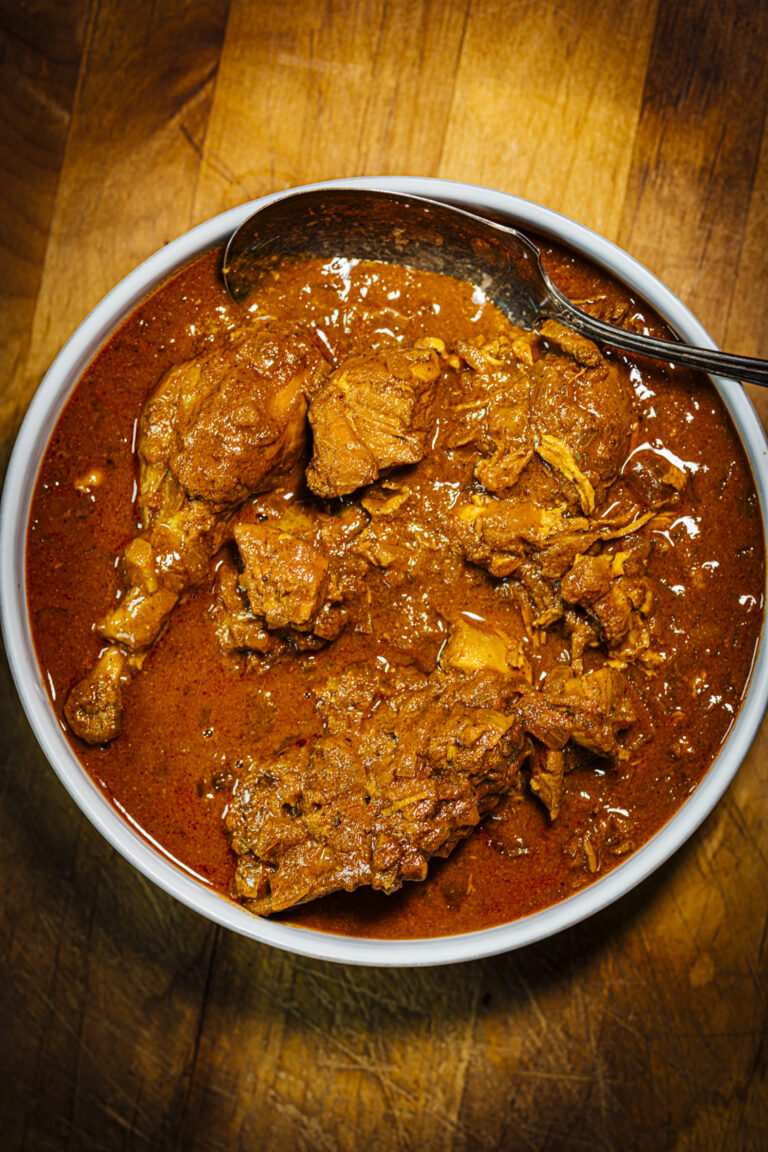
Chicken Vindaloo
Vindaloo is an iconic dish in Goan cuisine, often served on holidays, Christmas, Easter, and special occasions. The dish is famous for its bright red color, rich combination of aromatic spices, and generous use of vinegar. While pork is the traditional choice of meat used to make vindaloo, chicken also works well. In this version, I use bone-in chicken, but if preferred, you can also prepare this with boneless chicken. Unlike the pork version, this vindaloo does not need to sit in the refrigerator for several weeks and can be eaten the day it’s prepared. Personally, I prefer leaving it in the refrigerator for a day to help the flavors come together.
- Yield: 4 to 6
Ingredients
2 ½ to 3 lb/1.2 to 1.4 kg skinless bone-in chicken, cut into bite-sized pieces
12 whole cloves
10 to 12 garlic cloves/total weight about 30 to 35 g
2 in/5 cm piece fresh ginger, peeled and diced
1 in/2.5 cm cinnamon stick
1 tsp whole black peppercorns
½ tsp ground cumin
¾ cup/180 ml malt or apple cider vinegar
½ cup/120 ml water
1 tsp ground turmeric
3 Tbsp/45 ml neutral oil, such as grapeseed
2 large red onions/total weight about 800 g, diced
1 tsp sugar
Instructions
- Pat the chicken dry and transfer to a large mixing bowl.
- Grind the Kashmiri chillies, cloves, garlic, ginger, cinnamon, peppercorns, cumin, vinegar, and water together in a high-speed blender to get a smooth paste. Add the spice paste to the chicken with 1 tsp of salt. Fold to coat well and leave covered for 30 minutes at room temperature.
- While the chicken marinates in the vinegar spice mixture, cook the onions. Heat the oil over medium-high heat in a medium Dutch oven or non-reactive thick heavy-bottomed stainless-steel saucepan. Add the onions with a tiny pinch of salt and sauté until they turn light brown. The cooking time will vary. If the onions start to burn, add a tablespoon or two of water. Fold in the marinated chicken with the marinade. Stir in the turmeric and sugar. Reduce the heat to a simmer, cover with a lid, and occasionally stir to prevent the chicken from sticking to the bottom of the pot and burning. Cook until the chicken turns tender, opaque, and thoroughly cooked. If the liquid levels drop during cooking, add a few tablespoons of water.
- Once cooked, remove from the heat. The vindaloo can be eaten immediately, but I prefer to let it sit in the refrigerator for a day to improve the flavors. The chicken vindaloo can be stored in the refrigerator in an airtight container for up to 1 week.
Notes
- Vindaloo is usually made with palm vinegar, but I find malt and apple cider vinegar to be excellent substitutes, with malt being my top choice.
- Vinegar is primarily composed of acetic acid; it reacts with metals. I used a ceramic glazed Dutch oven or a non-reactive stainless-steel saucepan to prepare the vindaloo. Ideally, store the vindaloo in a non-reactive stainless-steel container or glass container in the refrigerator.
- Because acetic acid is harsher on meat muscle proteins that lactic acid, do not marinate the uncooked meat for more than 30 minutes, or the texture won’t be as tender.
- The quantity of spices like the cloves might seem intimidating but if too little is used, it won’t come through the vinegar.
- While I’d rather you use whole Kashmiri chillies for this recipe, you can use the powder but the flavor will not be as nice. You can use this conversion: 1 Tbsp of ground Kashmiri chilli powder comes to about 4 whole Kashmiri chillies.

From the book
Love bold, spice-forward cooking?
If you enjoyed this vindaloo, you’ll find even more flavor-packed recipes in Fundamentals of Flavor, including My Tandoori Chicken, Goan Feijoada, Goan Meatballs in Tomato Curry, Chicken Biryani, and Tamarind Shrimp with Curry Leaves.
Alongside every recipe, I share the techniques and flavor principles that make them work.
Preorder Fundamentals of Flavor →100 recipes · Science-backed techniques · September 2026
Complete Your Table
If you made this chicken vindaloo and loved the bold flavors of Goan cooking, here are some other recipes to round out the meal:
- Basmati Rice: The essential base for vindaloo. Learn the science of perfectly cooked, fluffy grains.
- Homemade Naan: For scooping up every last bit of that spiced, vinegary gravy.
- Kachumber Salad: A crisp, acidic counterpoint to the richness of the vindaloo sauce.
- Pulled Pork Vindaloo: The pork version, for those who want to explore the traditional preparation.
Frequently Asked Questions
Can I use boneless chicken in this recipe? Yes. Boneless thighs work particularly well and stay juicy through the braise. Boneless breast is the most delicate option; watch the cooking time closely to avoid drying it out.
Why is the marination time only 30 minutes? Acetic acid in vinegar is harsher on raw chicken than lactic acid in dairy-based marinades. Marinating longer than 30 minutes can make the chicken mealy in texture. Thirty minutes is enough time to transfer flavor without compromising the meat.
What can I substitute for Kashmiri chillies? For whole chillies, use this ratio: 1 tablespoon of Kashmiri chilli powder equals 4 whole dried chillies. For powder, substitute 3/4 teaspoon smoked sweet paprika plus 1/4 teaspoon ground cayenne per 1 teaspoon of Kashmiri chilli powder.
What vinegar works best for vindaloo? Malt vinegar is the closest substitute for the traditional Goan palm vinegar. Apple cider vinegar is also excellent. Avoid white distilled vinegar.
Can I add potatoes to this dish? Potatoes are not traditional in Goan vindaloo. They are sometimes added in restaurant interpretations, particularly in the UK and US. If you want to include them, add diced, parboiled potatoes in the final 15 minutes of cooking.
Can I make this ahead of time? Yes, and it is encouraged. The vindaloo tastes better after a day in the refrigerator.
What should I serve with chicken vindaloo? Basmati rice or bread (naan, crusty white bread, or poi, a Goan bread) are the most natural pairings. The starch absorbs the vinegary sauce and balances the acidity.
Why do I need to use a non-reactive pan? Vinegar’s acetic acid reacts with metals like aluminum and cast iron, which can impart a metallic taste to the dish and discolor the sauce. Use a ceramic-glazed Dutch oven or stainless-steel saucepan.

52 Responses
Can you use Kashmiri chili powder?
You could but whole chillies seem to work much nicer here in terms of flavor and color.
What’s the equivalency? I only have the powder at the moment and want to make it right now!!
4 whole Kashmiri chillies comes to about 1 Tbsp of ground powder.
Didn’t use cloves and turned out great
That’s lovely to hear, thank you for making it.
I see you’re a pretty legit chef so I’m gonna trust you on this. The video you shared doesn’t look like what I’ve got going on. Admittedly I did not have Kashmiri chilis and substituted Arbol chilis. Will update once it’s done. For now I’m giving 3 stars because I hate when people say things like “cook until done”
I want to make your chicken vindaloo, but I’m confused about the chicken instruction. You call for skinless, bone in chicken, and then say to cut it into small pieces. What about the bones?
I cut them with a meat cleaver. You can also add the uncut chicken pieces direct and adjust the cooking time.
Is it super hot ?
I’m doing it anyway!
You’re the best!
Thom
Kashmiri chillies are very mild in heat, Use half the chillies or toss the seeds and midrib out to cut back. The color and smokiness won’t be as strong when you use half.
I only have an immersion blender. Would this still work for the marinade?
It will work but takes a little more effort.
Interesting
I’m used to seeing a bunch of black cardamom pods
Cardamom (green or black) is not used in vindaloo, cloves take a more prominent position in many savory Goan dishes. The use of cardamom (black or green) would be more of a North Indian/restaurant interpretation of vindaloo.
Hi Nik. Thanks for this recipe. Question… I’m thinking about substituting the pork you said your aunt uses. How would the method differ?
How do I tweak the recipe for pork?
I will share a recipe using pork on a later date here, Stay tuned!
Nik,
I’m planning to make this using pork.
Few questions :
– how long should I marinate the pork?
– can I use the instant pot to cook it? Any recommendations on how long it should be cooked?
Thanks
Third time making it and this time added red potatoes:it was fabulous!!
What chili would substitute for a Kashmiri chili if you can’t get them?
This substitution works for Ground Kashmiri chilli – for every 1 tsp of Ground Kashmiri chilli powder use 3/4 tsp smoked sweet paprika and 1/4 tsp ground cayenne.
Dying to make this – in the video you say add the marinated chicken to the onions with some water. How much water?
Just a few Tbsps to prevent burning, though you might not need to depending on how much water is released during cooking. It’s in the last line of step 3 of the instructions.
Thank you so much Nik.
Your recipes are good,, and this is another good one.
I have a question about Kashmiri chilis. The ones that I get a a little hotter than jalapeno peppers, but they are a lot milder than habanero peppers. I get mine from Indian Diaspora Spice Co. They source their spices from small Indian farms that use traditional methods. They have a note saying that many people know Kashmiri chilis as mild, but that is because merchants without access to Kashmiri chilis substitute others. The ones that I get have a lot of complexity in addition to the heat. What are your thoughts on this?
Hi Bruce,
I use the same Kashmiri chilli powder from Diaspora Co. and I don’t find it hot. I think it’s comparable to other brands on the market both in India and outside. Regarding the heat level of Kashmiri chilli, even the Indian Govt’s Agricultural Code Book classifies it as a low heat chilli and this fact is well established by others. It’s a chilli used for color and not for heat, there are other chillies that can provide more heat and the bright red color.
Hi Nik,
I can’t wait to try this. You have garlic cloves listed twice in the ingredients list. Do you recommend using 10-12 cloves, or 20-24 separated? Sorry if this is a dumb question. Thanks in advance,
Bart
Hi Bart, the recipe is correct. Cloves are a spice while cloves of garlic refer to the individual segments in the bulb.
Aaaaaaaand now I’m embarrassed 🙁
I completely misread that. Thank you for taking the time to clarify. Planning to give this a go this evening. Have a great day.
No worries, it happens to the best of us!
I love that you use cloves and vinegar in the recipe, I was told there is no point in my eating vindaloo if I tone down the heat, however, I love the flavours. Maybe I should call it something else to avoid offending everyone!
Can I use boneless/skinless chicken breast here? Thanks.
Yup, they will work, so will thighs.
Hi Nik,
Are you sure about the amount of liquid (vinegar + water) for the marinade? I just made it and it came out much more watery than a paste.
Thanks,
Vazheh
Yes, the method is correct. If you’ve overshot the amounts, it’s not a big deal because it’s going to heated.
Making this tomorrow for the lads.
How do you adjust the vinegar and water if using chili powder instead of whole chillies? I think that’s why I got more of a liquid mixture than a spice. Thank you!
Just boil the liquid out till you get the consistency you prefer
Hi Nik,
I followed the recipe to the t, but my marinade was much runnier than a paste. Any clue what i might have done? Everything smells wonderful but I’m having to allow the some of the liquid to cook off.
Boiling it off is absolutely okay.
I’ve cooked this several times and it’s fantastic
However,I no longer use cloves because it takes away some of the sour taste and I love sour.
Also add Garam Massala to bring the spicy level way up
Great recipie especially when served with naan and basmati rice
Thanks,Joe
Hello Mike,
I would like to try this with the traditional pork. What cut would you recommend.
I would use 1/4 pork belly, and the rest would be the pork butt.
Hi Nik,
Quick question (and probably a silly one) about the onions. I have diced 2 very large red onions and they only come to 450g diced. Should I add another 2? Also do brown onions work in this recipe?
Thankyou!
I cannot wait to make this!
Can you share the recipe for pork?
Try the Pulled Pork Vindaloo recipe
hi Nik, I have kashmiri chilli flakes not powder , how much should I use ?
Thanks Cathy
For 1 teaspoon of powder, you’d need about 2 medium whole chiles (or 3 if they’re on the smaller side).
That seems like a heck of a lot of onions 800g ?
This is the correct, tested amount for this recipe.